
Measurement
How to measure sponsorship ROI
How to check what your sponsorship achieved, count the full cost and decide whether to sponsor again.

Define success before the agreement
Before you sign, choose what you want to achieve and record your starting figures. For example, track product trials, new customer contacts, sales or awareness of your brand.
Choose indicators the opportunity can reasonably affect. A hospitality program and a national awareness partnership should not be judged by the same scorecard.
Separate delivery from impact
First, check that you received what was promised: the booth, posts, ads or mentions. Then ask what happened as a result: did people watch, try the product, get in touch or buy?
Both checks matter. Seeing an ad does not mean someone became a customer. Report what ran and how people responded as separate results.
Measure the full investment
Include the sponsorship fee, setup, paid ads, staff, product samples and tracking costs. Leaving costs out makes the return look better than it was.
If you cannot reliably connect sales to the sponsorship, say so. Report other results, such as suitable customer contacts, samples tried or content views. Do not present those results as profit.
Create a decision, not a report
Finish with a clear decision: what worked, what needs to change and whether you should sponsor again. Focus on the results that matter to your original goal.
Compare results with the original objective and with credible alternatives. This keeps renewal discussions focused on future value rather than activity alone.
Compare your next sponsorship opportunityExample: calculate the return on your spending
Example only: a sponsorship fee of $20,000, setup and activity costs of $10,000, and tracking costs of $2,000 total $32,000. Suppose additional sales caused by the sponsorship produce $40,000 after product and delivery costs, before sponsorship costs. The return is ($40,000 − $32,000) / $32,000 = 25%.
If the same campaign records 200 qualified leads, cost per qualified lead is $160. That is an efficiency metric, not proof of positive financial ROI. Do not treat all leads as sales or all revenue as profit.
- Record the baseline and attribution window before launch.
- Separate observed sales from incremental sales and state the attribution limitations.
- Report contracted delivery, audience response and financial impact separately.
Work out your numbers.
These are example figures. For added sales, use only sales caused by the sponsorship, after subtracting product and delivery costs. Do not subtract sponsorship costs yet; this calculator does that below.
- Total sponsorship cost
- $32,000
- Profit after sponsorship costs
- $8,000
- Return on investment (ROI)
- 25.0%
- Cost per potential customer
- $160
ROI = (profit from added sales − total sponsorship cost) ÷ total sponsorship cost, shown as a percentage. Inputs stay in this browser and are not submitted.
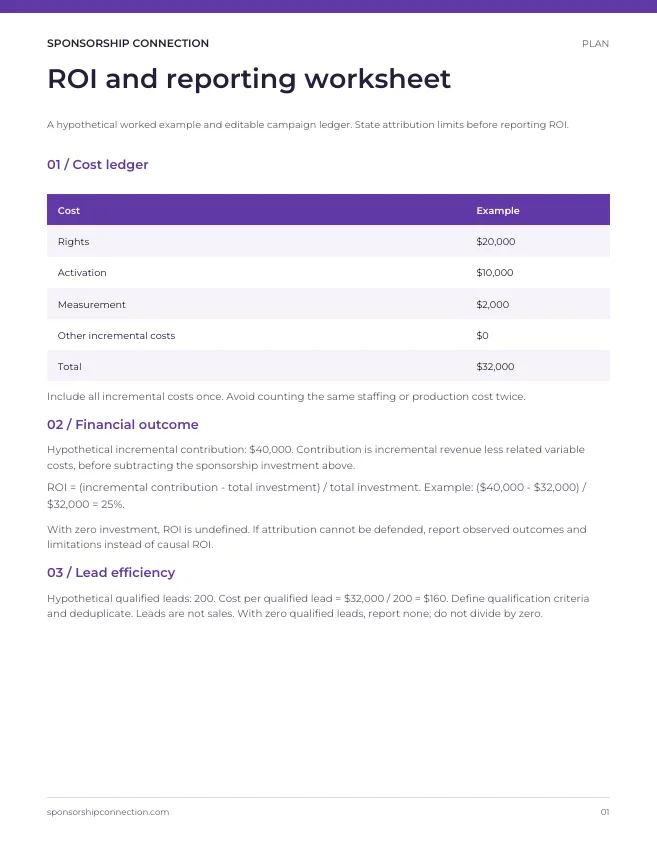
Put this guide to work
Download a fillable PDF with a worked example and fields for your own brief. Examples are hypothetical and are not client results.
Download: ROI and reporting worksheetFrequently asked
Questions decision makers ask
What is sponsorship ROI?
Sponsorship ROI compares the financial value created with the total cost of the partnership. When direct financial attribution is not possible, teams should also report clearly defined business and brand outcomes.
Which sponsorship metrics matter most?
The most useful metrics are tied to the original goal. Common measures include qualified reach, engagement, leads, trial, hospitality use, content performance, brand lift and attributable revenue.
When should sponsorship measurement begin?
Begin before the agreement is signed. Define the objective, baseline, data sources, reporting responsibility and decision criteria while the rights are being structured.
Put this into practice
Brand sponsorship strategy
Choose partnerships for a clear business reason, not simply because an audience is available.
Explore the service